
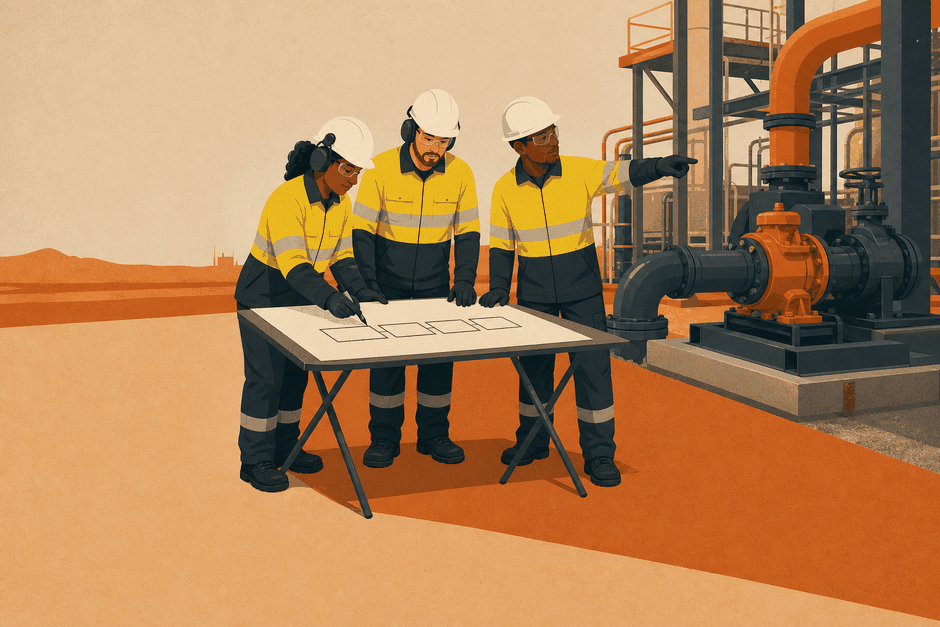
By the end
What you'll build
- Break a job into steps and identify credible hazards at each step
- Rate risk with a consequence and likelihood matrix and defend the rating to someone who disagrees
- Distinguish controls that reduce likelihood from controls that reduce consequence, and select accordingly
- Identify the critical controls for a high-consequence hazard and state how each one is verified
- Write a risk assessment record that another person can follow and challenge
- Recognise when a task has changed enough to require a fresh assessment
Curriculum
What's inside
7 modules · 41 lessons
- 01
Framing the Assessment
6 lessons- Scoping a Task So the Assessment Stays Honest
- Job Steps Versus Job Descriptions
- Who Belongs in the Room
- Baseline, Issue-Based and Continuous Assessment
- Using Past Incidents as Inputs
- + 1 more lesson
- 02
Finding the Hazards
6 lessons- Structured Prompts That Surface Hidden Hazards
- Energy-Based Hazard Prompts
- Walking the Task Instead of Imagining It
- Interfaces: Where Two Crews Meet
- Hazards That Only Appear on Night Shift
- + 1 more lesson
- 03
Assessing the Risk
6 lessons- Using a Risk Matrix Without Fooling Yourself
- Consequence: Reasonable Worst Case, Not Worst Imaginable
- Likelihood: Exposure, Frequency and Probability
- Common Rating Biases and How to Push Back
- Recording the Reasoning, Not Just the Score
- + 1 more lesson
- 04
Choosing and Proving Controls
6 lessons- Critical Controls and How They Are Verified
- Preventive Versus Mitigating Controls
- Control Effectiveness and Degradation Over Time
- Bow-Tie Thinking for High-Consequence Hazards
- Naming an Owner for Every Control
- + 1 more lesson
- 05
Residual Risk and Sign-Off
6 lessons- Deciding Whether Residual Risk Is Acceptable
- Escalation Thresholds and Who Decides
- Reasonably Practicable in Plain Terms
- Documenting Assumptions and Limits
- What a Reviewer Should Challenge
- + 1 more lesson
- 06
Keeping Assessments Alive
6 lessons- Triggers That Force a Re-Assessment
- Change of Plant, People, Process or Place
- Field Verification of Controls
- Feeding Incident Findings Back In
- Retiring and Archiving Superseded Assessments
- + 1 more lesson
- 07
Practice and check
5 lessons- Risk assessment words that get mixed upmatch pairs
- Building an assessment that survives scrutinysequence order
- Rating and reviewing honestlyfill blank
- The assessment that no longer describes the jobscenario
- Course quizquiz
The shape of it
How this course works
Short lessons
41 lessons across 7 modules, each small enough to finish in one sitting.
Practice as you go
Every lesson ends with a small space for what you noticed — the doing is the learning.
Progress you can see
Your progress is saved lesson by lesson, ready whenever you come back.
Ready when you are.
Make an account and this course opens up — your progress is saved from the very first lesson.